Accuracy ±0.1 mm
On small features. Holes come out up to 0.1 mm small because powder sticks to their walls; pins come out a little fat. Drill or ream a hole that must fit a pin or a bearing.
Upload an STL, 3MF or OBJ. In a few seconds you see the price, the print time and anything that would go wrong, before you order. We print it in 316L stainless steel on a laser powder-bed printer in the USA, finish it and ship it to you.
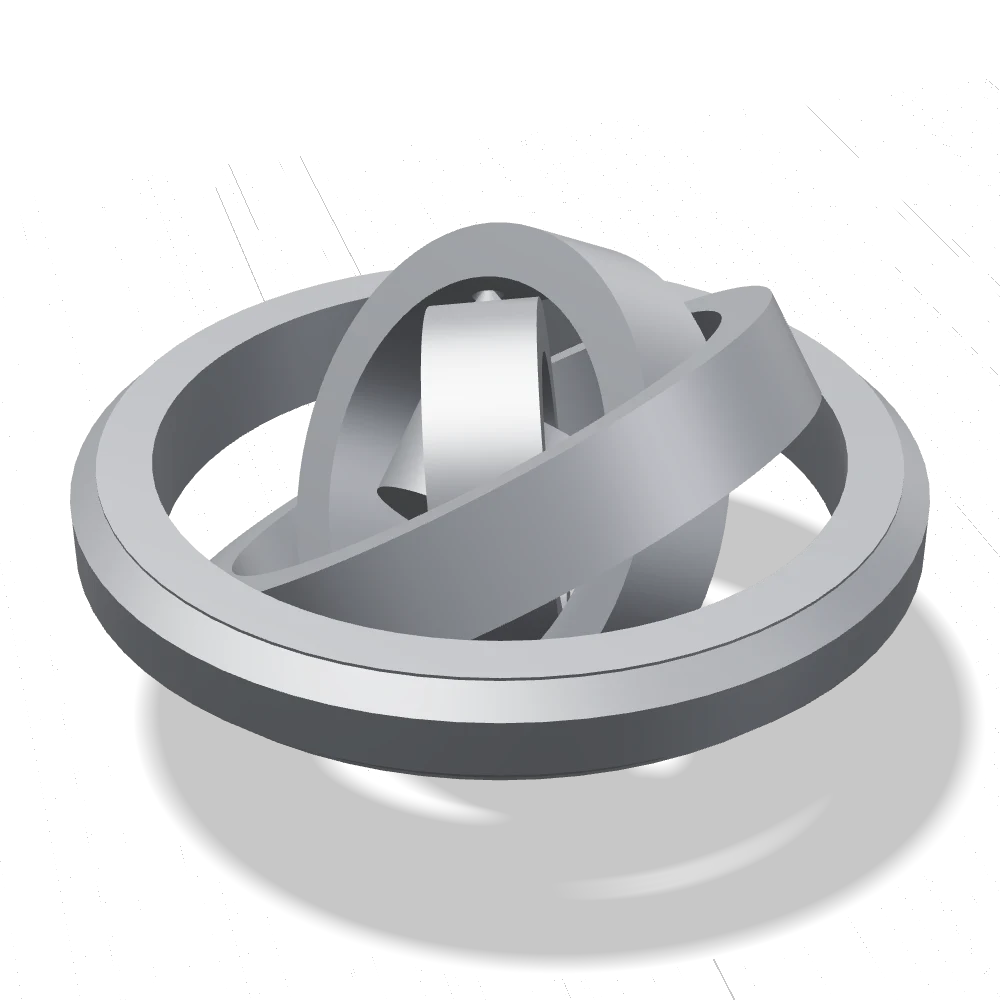
A real file, priced by the same calculator as the quote page. Picture is a render; the real part is matte, see below.
Pre-ordersPrinter arriving; first prints in early 2027. Pre-orders print first, in order.Reserved so far: –A new order ships about –
The quote page measures both from your file, in your browser, in a few seconds. Our server measures your file again before anything is charged, so the price you see is the price you pay.
$0.14per gram
Everything the laser melts: the part itself, plus thin supports under faces that point down. Steel weighs 8 g per cm³, so a part the size of a sugar cube uses about 8 g.
$17.50per hour
The printer builds a part one thin layer at a time. For every layer, a blade spreads fresh powder over the plate (7.2 seconds), then the laser melts that layer's slice. A tall part needs more layers than a flat one, so it takes longer even at the same weight.
$7.29per order
25 minutes of printer time to fill it with nitrogen and prepare the plate, once per order however many parts are in it. US shipping is $8. An order under $25 is charged $25.
| Steel | 81.2 g in the part + 8.3 g of supports = 89.5 g × $0.14 | $12.53 |
|---|---|---|
| Printer time | 159 layers × 7.2 s to spread powder = 19 min, plus 1 h 52 min of laser melting = 2 h 11 min × $17.50 an hour | $38.25 |
| Price of the part | $50.78 | |
| Setup, once per order | 25 min of printer time to fill it with nitrogen and prepare the build plate | $7.29 |
| Shipping in the US | Tracked, flat rate | $8.00 |
| Order total | $66.07 |
Layers come in two heights. Fast, 60 µm (0.06 mm) is standard. Fine, 30 µm halves the little steps you can see on gentle slopes, but needs twice as many layers, so it takes about twice the printer time. Most parts look the same either way; fine layers help small curved parts like rings. Compare them in the close-up below.
Every price below comes from the real file run through our calculator: one part, fast layers, before the $7.29 setup and $8 shipping. "Fine" is the same part in 30 µm layers. All of these print in one piece, moving parts already assembled.
Four nested rings and a core that all swing freely. Printed flat, already assembled: 5 parts, 1 print.
$50.78fine layers $88.99

A ring with a fluted band that spins around it. US size 9 shown; sizes 7 to 11.
$13.84fine layers $25.59

Fidget spinner with three lobes that turns on its own printed hub. 2 parts, 1 print.
$43.93fine layers $77.30

Planetary bearing: 7 gears that turn together, printed already meshed.
$34.55fine layers $61.64

A dragon of 34 linked segments that bends and curls. Printed flat in one go.
$40.42fine layers $72.07

One pawn from the lattice chess set: an open lattice body on a solid base.
$20.08fine layers $38.16

The king from the same set. Printed lying down: fewer layers, lower price.
$34.57fine layers $64.22

A steel ball trapped in a maze inside a cube. Tilt it to find the way out.
$70.11fine layers $128.50
All 11 example partsFull price table and how each number is made
Honestly: plain, chunky parts are cheaper from China, if you can wait a week or two and your part has no detail under 1.5 mm. US metal print bureaus start at about $150 for one small part. We sit between the two: printed and shipped in the US, details down to 0.3 mm, and the price known before you order.
| Service | Spinner ring 13 g of steel | Chess pawn 11 g of steel | Gyroscope 81 g of steel | Mini fractal vise 158 g of steel | How we worked it out |
|---|---|---|---|---|---|
| Print in Steel USA · this site | $13.84 | $20.08 | $50.78 | $93.82 | Our calculator, fast layers. Add $7.29 setup and $8 shipping per order. |
| JLC3DP Shenzhen, China | $14.00 | $14.00 | $23.06 | $39.23 | $0.21 per gram, at least $8, + about $6 shipping and tax to the US (one buyer's real cost on a light parcel). 1.5 mm smallest feature. |
| US metal print bureaus Xometry, Protolabs, Forecast3D, Quickparts… | None publishes a price rule, so they cannot be priced part by part. The lowest real prices found for one small metal part: $150 (Forecast3D), $155 (Terrapin Works estimate), $193 (Quickparts), $538 (Protolabs). | Quotes published by All3DP and the services themselves, 2024–2026. Details and sources. | |||
Prices read 23 November 2026. JLC3DP is the only service that publishes a price rule for 316L, so it is the only one that can be priced part by part. 16 services compared, with sources.
Photos of metal prints online are usually polished or retouched. Ours come out of the printer with a fine sandy skin, then get bead-blasted to an even satin grey. Pick a face of the part, zoom from hand-held to microscope, and drag the divider to compare finishes. Drag the picture to move the light.

A vertical wall. Each layer leaves a faint line; grains of half-melted powder stick all over it. This is most of the surface on most parts.
Laser-melted parts come out strong and dense, with a few habits of their own. Each one below is drawn to scale.
On small features. Holes come out up to 0.1 mm small because powder sticks to their walls; pins come out a little fat. Drill or ream a hole that must fit a pin or a bearing.
Faces that point down are printed on supports. We cut them off, which leaves rough ridges on a 1 mm grid. The quote page shows these faces in orange before you order.
A face that leans only a little shows its layers as tiny steps, 0.06 mm tall (0.03 mm with fine layers). You can feel them with a fingernail.
Cut a part in half and polish it: about 0.2 % of the area is tiny pores. Printed 316L is typically as strong as 316L bar or stronger, and a little less stretchy. Not heat-treated unless you ask.
Moving parts print already put together, with a gap of loose powder between them. The powder right next to each wall partly melts on, about 0.1 mm per side, so the gap you draw has to be wider than that.
Frees with a firm twistA thin crust joins the parts at first. A firm twist breaks it and then they move. Our minimum.
A printed thread comes out about 0.1 mm off: a little fat, and rough. On a big thread that is nothing; on a small one it fills the groove.
Too fine to print. Tap it instead.Model a plain Ø2.5 mm hole and cut the thread with an M3 tap after printing, or tell us and we tap it.
Pitch 0.5 mm · thread depth 0.31 mm · tap drill Ø2.5 mm
Loose powder fills every space inside the part while it prints. If a hollow is closed all round, the powder can never get out: it adds weight and rattles. Make the part solid, or add two drain holes of at least 2 mm. The quote page flags sealed hollows.
On a SnowX SnowPod, a desktop laser powder-bed printer. It works like the half-million-dollar industrial machines, at the size of a microwave oven, which is why small parts cost less here.
We cut the part off the plate, remove the supports, blow out the loose powder and bead-blast it with fine glass beads. That is what turns the dull, sooty skin into the even satin grey you saw above.
We check it against your file, pack it and ship it in the US with tracking. Optional tumbling ($6 a part) rounds sharp edges and makes it a little smoother; it does not make it shiny.
Shows where your part is in the queue, when it prints, and the tracking number. More about the process.
We print on a desktop laser powder-bed printer instead of a large industrial machine, and price each part from the steel and machine time it really uses. Big services add engineering review, minimum charges and overheads to every order.
Our printer is on order. You can order now at today's quoted price and keep your place in the queue. We charge nothing until your part is next; then we email you a payment link. Cancel any time before paying.
Up to 76 × 76 × 97 mm, in whichever position fits. Bigger parts can be split and joined; ask us.
316L is a food-grade alloy, but the printed surface has microscopic pores and grain that are harder to clean than polished steel. We do not certify parts for food contact.